Score CSP
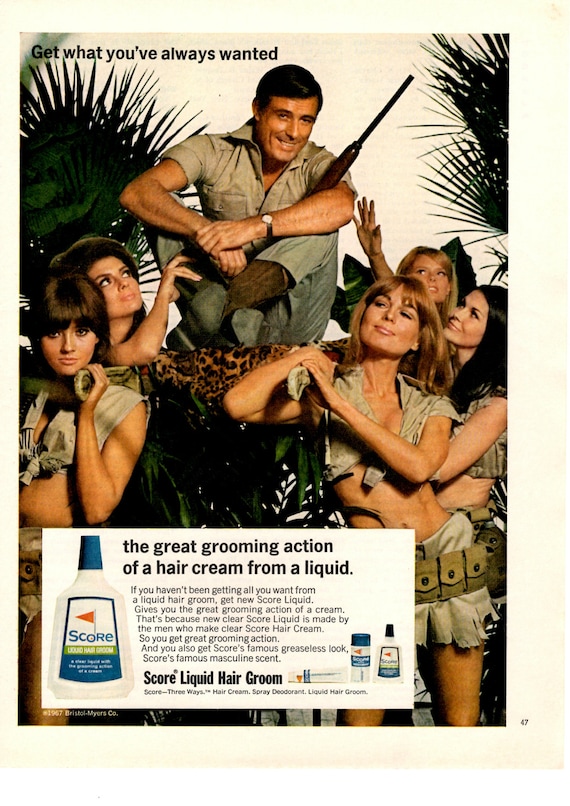
A pre- 1970's print advertisement for hair cream for men. The exam board state:
The score hair cream advert
1967
Who is the target audience?
Young adult men
- Women presented as objects of the male gaze
- Depiction of hypermasculine male
- Produced during the 1960s, young people becoming more liberated - ideas of meterosexuality
How does the advert reinforce dominant, hegemonic and patriarchal ideologies?
Context
The swinging 60s - More disoposable income, grooming producs were very popular. Men's hair brands like Score and Brylcream were commercially successful and widely used
Barthes
The wrifle using Barthes is a signifier of powe, dominance and control
Cultural aspects Intetextual references to same
Why has the product made these choices about how to represent these social goups?
One reason why the product have made these choices as they would like to appeal to the primary male target audience
humour involved - makes it seem like a lighthearted brand
Women share a bond
Historical
Patriarchal ideology
Gender stereotyoe around ay that tume
How are representations of masculinity shaped by cultural and historical contexts? (12 marks)
One way that the representations of masculinity is shaped by cultural and historical contexts in relation to the score advert is that British male in the advert is presented as superior and dominant to the women through his positioning in the advert, which alludes to the British Empire and how it dominated other countries. By 1922, British Empire contained one-quarter of the world's population.
Another representation of massulinity is that the influence of feminism
The score hair cream advert
1967
Who is the target audience?
Young adult men
- Women presented as objects of the male gaze
- Depiction of hypermasculine male
- Produced during the 1960s, young people becoming more liberated - ideas of meterosexuality
How does the advert reinforce dominant, hegemonic and patriarchal ideologies?
Proxemics: women positioned below the male
- Women presented as objects of the male gaze (direct address, clothing etc.)
- Ideas of hypermasculinity: gun, muscles etc. connote strength and power
- Women presented as objects of the male gaze (direct address, clothing etc.)
- Ideas of hypermasculinity: gun, muscles etc. connote strength and power
How does the advert depict hypermasculinity?
Man is holding a gun, positioned/sitting in a way that enhances and draws attention to his muscles
What are the connotations of the word 'score'?
Slang for getting with a girl.
- Presents women as the prize (Propp's narrative theory)
- Suggests hair cream will help men to attract women; encouraging them to buy it by using patriarchal ideals
- Presents women as the prize (Propp's narrative theory)
- Suggests hair cream will help men to attract women; encouraging them to buy it by using patriarchal ideals
Direct address
The woman positioned front left:
Shows the advert is made for male consumption. Seducing the male audience and inviting them to objectify and gaze upon her - promotes voyuerism.
Shows the advert is made for male consumption. Seducing the male audience and inviting them to objectify and gaze upon her - promotes voyuerism.
Proxemics
The male is positioned higher than the women, therefore conforming to hegemonic ideologies.
How could 'Score' be seen as a reflective representation (Stuart Hall)?
Nice hair DOES make someone more attractive
- Heteronormative: straight people are an in-group, LGBTQ+ are an out-group; advert assumes most/all men are straight. Historical context - homosexuality decriminalized the same year.
- Reflects hegemonic ideologies involving patriarchy
- Heteronormative: straight people are an in-group, LGBTQ+ are an out-group; advert assumes most/all men are straight. Historical context - homosexuality decriminalized the same year.
- Reflects hegemonic ideologies involving patriarchy
How does 'Score' conform to the codes and conventions of a print advertisement?
- Slogan in towards the top
- Includes an image of the product
- Anchorage copy giving information about the hair cream
- Includes an image of the product
- Anchorage copy giving information about the hair cream
How does 'Score' subvert the codes and conventions of a print advertisement?
Doesn't use celebrity endorsement - perhaps to make it more relatable to the audience.
Costumes/setting: Colonialism
Advert is set in a tropical country (signified by leaves in bg and khaki clothing) that houses terrain such as rainforests and jungles. This type of environment cannot be found in UK or western European countries so it alludes to the idea that western countries have colonised areas such as Africa and Asia, where you would find these jungles.
Representation of men as superior - Colonialism
The representation of a hypermasculine man, aided by the gun and proxemics, relates to the idea that the men who were sent to colonize these countries were viewed as heroes e.g. Columbus despite the fact that innocent people were killed to gain land (gun alludes to this).
Colonialism & trade
The gun and leopard are indexical signs that an animal has been killed. These links to the fact that when white men were colonialising these countries, they stole their resources and restricted trade to the lower class colonies.
Proxemics - Colonialism
British male in the advert is presented as superior and dominant to the women through his positioning in the advert, which alludes to the British Empire and how it dominated other countries. By 1922, British Empire contained one-quarter of the world's population.
Stuart Hall - Who from a contemporary audience would take the dominant reading?
Older men - have grown up with that regressive lifestyle and may still believe it.
Stuart Hall - Who from a contemporary audience would take the negotiated reading?
Men that want to look good but do not agree with the representations seen in the advert.
Stuart Hall - Who from the 1960s audience would take the oppositional reading?
Women, gay men - due to representiation of women as inferior and 'the prize' (Propp), whilst the advert is heternormative so gay men are excluded from the advert
Stuart Hall - Who from the 1960s audience would take the dominant reading?
Heterosexual, white men
Gramsci - Hegemony
- Advert produced by men; more likely to be heteronormative and sexist
- Working class at the time may have had less access to the 'real world' so their beliefs are more likely to be swayed by these hegemonic views
- Working class at the time may have had less access to the 'real world' so their beliefs are more likely to be swayed by these hegemonic views
Van Zoonen
Media portray images of stereotypical women and this behaviour reinforces societal views. This is a patriarchy that dominates and oppresses women.
- Proxemics: positioned below men
- Clothing: presenting them as objects of the male gaze (Laura Mulvey)
- Smiles are symbolic signs of desire, presented as animalistic and 'chasing' the man
- Proxemics: positioned below men
- Clothing: presenting them as objects of the male gaze (Laura Mulvey)
- Smiles are symbolic signs of desire, presented as animalistic and 'chasing' the man
Stereotypical representations of the hypermasculine male as the 'hero' and the inferior women as the 'prize ' (Propp)
Gerbner - Cultivation Theory
Can be applied to sexual stereotyping: long-term exposure to misogynistic & pornographic content cultivates a social system in which the objectification & subjugation of women is tolerated.
John Berger
(Non prescribed theorist) would say in the advert "men act, women appear (Ways of seeing,1972)
John Berger
(Non prescribed theorist) would say in the advert "men act, women appear (Ways of seeing,1972)
Context
The swinging 60s - More disoposable income, grooming producs were very popular. Men's hair brands like Score and Brylcream were commercially successful and widely used
Barthes
The wrifle using Barthes is a signifier of powe, dominance and control
Cultural aspects Intetextual references to same
Why has the product made these choices about how to represent these social goups?
One reason why the product have made these choices as they would like to appeal to the primary male target audience
humour involved - makes it seem like a lighthearted brand
Women share a bond
Historical
Patriarchal ideology
Gender stereotyoe around ay that tume
How are representations of masculinity shaped by cultural and historical contexts? (12 marks)
One way that the representations of masculinity is shaped by cultural and historical contexts in relation to the score advert is that British male in the advert is presented as superior and dominant to the women through his positioning in the advert, which alludes to the British Empire and how it dominated other countries. By 1922, British Empire contained one-quarter of the world's population.
Another representation of massulinity is that the influence of feminism
Comments
Post a Comment